
A brief ferry ride from the glitz of the French Riviera, the Hyères Islands offer an idyllic escape into protected pine forests, unspoilt beaches – and one of France’s most unique communities.
The ferry ride from the Giens Peninsula takes just about 15 minutes, but when my feet touch the vehicle-free streets of Porquerolles, the French Riviera’s glittering mainland already feels worlds away.
Porquerolles is one of the three Hyères Islands (Îles d’Hyères), an archipelago stretching eastward from Giens like an ellipsis in the Mediterranean Sea. While the French Rivera lures visitors with its glamorous resorts and timeless elegance, it’s often overrun by traffic and showy crowds. These islands, covered in pine forests and blissfully car-free, offer an unassuming alternative to the glitz of Cannes and Saint-Tropez.
Stepping off the ferry, the cacophony of cicadas floods my ears. I’m well-accustomed to this soundtrack of southern France, but I’ve never heard them at such a pitch – here, no motors cut their hum. The harbour is fringed with pines, palm trees and sunset-coloured houses. Cyclists whirl by, dismounting to stroll down the main thoroughfare, where everyone seems to have an ice cream in hand.
Having sat in traffic for hours to enter Saint-Tropez and shoulder-bumped strangers along the crowded lanes of Èze, I’ve yearned to find an unspoilt corner of the French Rivera – one with thyme-scented breezes and luminous beaches. The Hyères Islands just might be it.
Three islands, three rhythms
Also called the Golden Islands (Îles d’Or) for their sun-shimmering schist bedrock, the Hyères Islands have been inhabited by monks, pirates and Napoleon’s military over their 2,400-year history. Since 1963, they’ve formed part of Port-Cros National Park, with strict protections: no camping or loud noise and a near-total ban on smoking due to wildfire risk.
Each isle has a its own vibe: cyclists’ paradise Porquerolles; outdoorsy Port-Cros; and free-spirited Levant, home to France’s best-known nudist community.
Plan your visit:
When to go: April-October
Get there: Ferries run year-round to the Hyères Islands from the Giens Peninsula. Boats to Porquerolles (15-20 minutes) leave from Tour Fondue; to Port-Cros and Levant (45-60 mins) from Port d’Hyéres. There are also ferries between Port-Cros and Levant, but no routes between Porquerolles and the other islands
Stay: Porquerolles has the widest choice of hotels; Port-Cros has limited options (bring provisions); Levant has a handful of guesthouses.
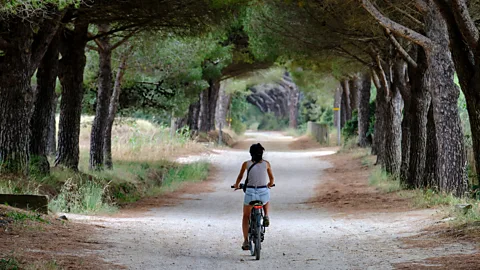
On Porquerolles I am eager to explore its 51km of bike paths. Cars were banned in 1985, and while the island is completely pedestrian-friendly, cycling is the classic way to experience the forests, beaches and the island’s sole village, which hums with restaurants and shops.
I hire a mountain bike from Velos a Porquerolles and set off along shaded pine-scented paths. At the crescent-shaped Notre Dame Beach – one of several white-sand beaches along Porquerolles’ north coast – people snorkel and lounge. The beach is ringed with oak and Aleppo pines, some of which stretch out over the transparent water as if tempted to jump in.
“There’s a different spirit than on the coast,” says Laura Barbier, who owns specialty grocery Chez Laura in the village. “There is no traffic, no cars. It’s amazing. The slow life.”
Embracing this slow life includes outdoor wine tasting. In 1912, mining mogul François-Joseph Fournier planted 180 grapevines after giving Porquerolles as a wedding present to his wife; today, some of these historic vines are used to make the celebrated rosé wines of Domaine La Courtade at Villa Carmignac. Sommelier Caroline Aubry explains to me how the island’s micro-climate, schist and mistral winds, which “clean” grapes of destructive bacteria, are ideal for production.
At the villa’s sprawling sculpture garden, I walk past wind-whipped lavender bushes, through green and golden land that seems to roll into the sea before cycling to the 16th-Century Fort Saint-Agathe for sweeping harbour views.
Porquerolles has not escaped overtourism and social media’s influence, however, which Barbier says has ruined undiscovered places. “There used to be little corners where only we went, but now everyone knows about them,” she says.
Indeed, after the number of visitors to Porquerolles became too great in high season (reaching above 12,000 in a single day) measures were put in place in 2021 to cap visitors.
“We are working on both limiting visitor numbers and managing visitor flows in order to preserve the island,” says Virginie Fernandez, manager of Port-Cros National Park Visitors Centre. This includes capping visitors at 6,000 per day, promoting Porquerolles’ lesser-known attractions and educating tourism industry professionals and businesses about how to pass good practices on to their clients. “It’s important to sensitise the public so they know how to respect such richly biodiverse areas,” she says.
Deeper into the wild
If Porquerolles still feels too busy, Port-Cros and Levant are the antidote.
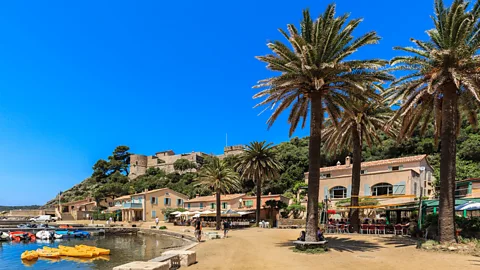
A 45-minute ferry from Giens, Port-Cros’s only sign of habitation is its port village; a blip of houses and restaurants that are overlooked by the 16th-Century Fort du Moulin, one of five forts on this craggy island. I cross the village in minutes, responding to strangers’ bonjours as I pass.
But what Port-Cros lacks in human trappings, it makes up for in wild beauty. Unlike Porquerolles, there are no bicycles as this hilly and densely forested island cannot accommodate them. Instead, 30km of hiking trails with striking views of the cobalt blue Mediterranean run through the island. One even goes underwater; starting near the shore of La Palud Beach (Plage du Palud), snorkellers can follow six underwater markers that explain the rich marine life, including 500 species of algae, a Neptune grass meadow and a wild array of colourful fish species.
In early morning, I walk cliffside under arching pines and olive trees. Rugged South Beach (Plage du Sud), framed by rocks and green forest, is empty when I arrive. A sailing boat bobs on the horizon, with an islet and the French coastline in the background. I can hardly believe that I am standing on an empty Côte d’Azur beach in the middle of summer.
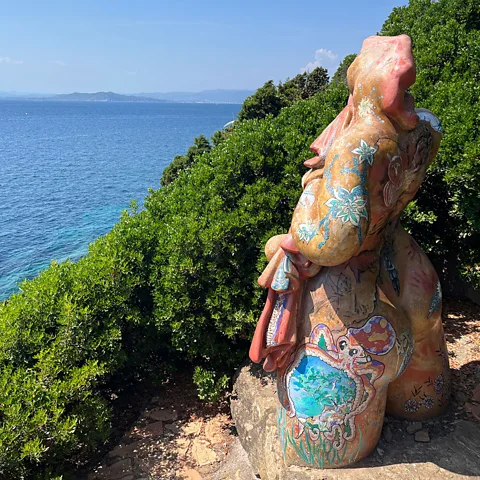
The next day, I set off for the untamed isle of Levant, whose land meets the sea in jagged cliffs. Ninety percent of this 1,000-hectare island is an off-limits military base. The remaining part is Heliopolis, a nudist colony founded in 1931. This private community is open to the public so long as people respect its spirit, which is to live simply and healthily in commune with nature, far from urban life’s constraints.
Clothing is optional throughout Heliopolis, save for Plage des Grottes – the island’s only sand beach – where nudity is compulsory. There is no public electricity, and with no natural ground source, water is scarce. Visitors and residents must limit noise, refrain from smoking and cover their seats if dining undressed. Everyone gets around on foot, as bicycles are prohibited on the steep, narrow streets.
A live-and-let-live-within-the-rules kind of attitude is palpable here, with people vocalising their appreciation for Levant as a unique, treasured space. People say bonjour when they pass; naked, clothed, resident or visitor. No one seems to be on their phones. When I ask locals why, I get similar responses: people want to be free of them.
More like this:
• The US neighbourhood where cars are banned
• The US island with no cars and one horse for every person
• St-Tropez: The town telling visitors to stay away this summer
“When we are on Levant, we live like we are on Levant,” says Marie-Pierre Romanello, owner of Adam et Eve Boutique. “You don’t bring your other way of life here. The spirit of freedom and simplicity must remain our way.”
“It’s the feeling of nature, the sea, freedom, the Sun,” that make this place special, says Heliopolis’ deputy mayor Frédéric Capoulade, who co-authored a book on its history “It’s also the quiet.”
At dusk I’m in Place Durville, the main square, where all ages – from toddlers to seniors – gather. Some wear shorts and t-shirts, others are in heels and sheer sarongs or nothing at all. Dogs run off leash. A basket of bread sits outside the shuttered bakery, for sale on the honour system.